


Introduction
The 7 Classical Virtues as a Spiritual Immune System
Self-Mastery – The Forgotten Key to Democracy's Survival
The word 'virtue' has long been dismissed as a relic of the past. Today, we are learning this the hard way: without virtue, democracy collapses.
Virtue is not about parading moral superiority or flaunting one's goodness. Rather, it is the art of creating harmony between reason, desires, and emotions.
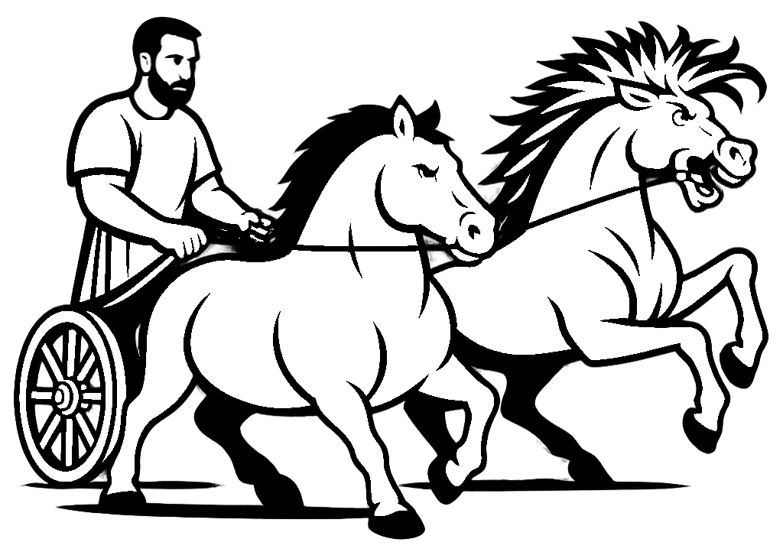
Harmonious strength.
As Plato pictured it, reason is like a charioteer, guiding one strong and one unruly horse along the right path. He believed that achieving this harmony is the key to true happiness.
When reason loses control – when the unruly horse takes the reins – everything veers off course. This is happening across the world today, even on the global stage.
Demagogues sow division and wreak havoc. Their lack of inhibition and self-control becomes prime-time entertainment. They are often praised as 'fearless truth-tellers' who 'say it like it is.' Many believe them because their words stir emotions and give a thrill. But unbridled passion – cut loose from reason's reins – rarely leads to truth.
💬 Ideas grow in group chats 🌱
Without virtue, no one is fit to steer a nation. Unruly horses drag the chariot into the ditch – and everyone with it. True leaders first learn to rule themselves before governing others.
Democracy rests on character and harmonious strength, in both leaders and citizens. Lose that, and the system crashes.
Emotions are crucial. They give us energy and set us in motion. Yet there's a risk. We often react to what we see and hear with knee-jerk aversion or approval – "I hate this," "I love that."
When every impression triggers a reflex, we have switched off our inner brakes. Without a pause for reflection, good judgment fades. Integrity weakens and we become soft targets for manipulation.
The key to freedom is self-mastery. For if you cannot steer your own chariot, someone else may seize the reins – and then you have sold your soul and lost your freedom.

💬 Ideas grow in group chats 🌱
Faustian temptation
The Faustian bargain is both a classical legend and a timeless metaphor. It tells the story of a deal with the devil, whereby someone trades their soul and moral integrity for power, wealth or status.
It begins the moment someone says, "I'll do anything to…" The offer may appear to be a shortcut to success, but beneath the promise lies a trap: seductive, yet ultimately enslaving. Who has the strength to reject the offer? This is the existential question of our time.
This doesn't just happen on a personal level – it can also unfold on a massive scale. Today, the consequences are clear and devastating. Demagogues – the masters of the power game – have embraced the Faustian bargain. Many are drawn to their charisma, their rage, their talent for sowing division and chaos. They appeal to people desperate for a saviour. They exploit emotions such as fear and pride.
Their actions betray a deep inner emptiness. To fill this void, they have an insatiable need to create a personality cult and exploit others. They have traded their moral integrity for personal gain – and they want others to make the same corrupt exchange.
Many people find their shamelessness and cruelty entertaining. They admire leaders who flout laws and norms with impunity. They revel in the buffoonery, the bullying and the meanness. The main attraction is the intoxicating illusion of strength and power.

In their eagerness to feel powerful, these followers have compromised their integrity. They do not realise that they have become prisoners of their own destructive impulses. Tug the strings of fear, pride, or anger, and they respond like puppets. Enchanted, they can no longer hear the voices of reason or compassion. They too have accepted the bargain. But what is there to gain if the price is your soul?
There is a way to say "no thanks" to the bargain – and hold on to your freedom and integrity. If you don't want to be used as a puppet, you need to build inner strength and character.
For centuries, people have turned to an ancient bulwark against this dark temptation: the seven classical virtues. Standing firm in this ever-repeating drama requires cultivating faith, hope, love, wisdom, just-mindedness, moderation, and courage. This is the classical way to build resilience against the Faustian pact.
Placeholder · quote card
1. Courage: Avoid the Path to the Dark Side
We live in a world torn apart by strong passions. Debates have become trench warfare, with people hurling insults at each other. Hate and fear are spread virulently online.
Fear doesn't bring out the best in us. In the movie Star Wars, the character Yoda famously said:
Fear is the path to the dark side. Fear leads to anger. Anger leads to hate. Hate leads to suffering.
Of course, it is important to be able to feel fear and anger. They are natural responses that can, at times, be a matter of survival. Anger can be an important driving force in some situations. But unchecked, these emotions pose a significant risk.
- Fear can create delusions.
- Anger can create tunnel vision.
- Hatred can create blindness.
Fear can stir up emotions that cloud judgement and prevent us from thinking clearly. Courage is the first defence against the 'dark side'. We must not allow fear to rule over reason. In stressful situations, it is important not to let your imagination run away with you.
Stoic courage is an important part of the spiritual immune system.
2. Just-Mindedness: Find Strength in Boundaries and Principles
"If you have authority, you can do anything you want" – fantasies of unchecked power can be exhilarating, and deeply dangerous. Such emotions cloud good judgment and fuel all sorts of twisted ideas.
To keep these emotions in check, we need the virtue of justice and just-mindedness. It is about being principled and resisting the temptations of power. Having authority does not give you the right to do anything.
Let justice rule: keep the law, act honourably and be truthful. Do this in all things, great and small, and do it even if it does not bring direct personal gain. Cultivate a sense of personal responsibility. Don't be mesmerised by grandiose displays of raw might.
Practicing restraint and acting honourably cultivate true strength. These good habits are also a safeguard against the delusions of power intoxication.
3. Love: Overcome Toxic Emotions
Why is social media so often anti-social? Why are the posts so full of mockery, abuse and petty nastiness? The answer is quite simple: Being nasty and mean can be a pleasure.
You laugh and make fun of others because it's amusing. You take pleasure in others' misfortune. Even the feeling of being wronged can become a wicked pleasure. It can provide an excuse to lash out in lustful anger.
Pleasant emotions = good emotions?
This is often the case, but not always. There are bad things that can feel good, for example: the pleasure of being mean, the desire to judge, the sweetness of revenge, the intoxication of power. Is there anyone among us who is completely free of this and who never deceives himself?
How do we break free from this "toxic trap"? Many people believe in an all-encompassing love that illuminates the dark corners of our souls without creating fear. This belief encourages self-examination and self-knowledge. It is a core concept of the Christian faith, where it is known as divine love. It is seen as a life force that cures or at least mitigates toxic emotions.
There are good reasons to undergo this 'detoxification'. Hatred and contempt can damage intellectual health. Moreover, those who love to hate are susceptible to manipulation. Clever demagogues can easily make them dance to their tune by pushing the right buttons.

💬 Ideas grow in group chats 🌱
4. Faith: Overcome Unhealthy Mistrust
Why do false conspiracy theories often become popular? Perhaps the answer is this: It can be flattering to think you have a sharp mind that can spot patterns that reveal hidden secrets. Distrusting experts and scientists makes you feel uniquely clever. What they say is rejected with a dismissive sneer. They become smaller and you become bigger.
Scientists are not perfect, so it can sometimes be justified to be sceptical. But there is also an unhealthy form of mistrust that comes from fear and low self-esteem. Such mistrust inflates the ego. It can make us surprisingly gullible. When we stop trusting self-correcting institutions, we often end up trusting self-appointed experts who answer to no one.
"Critical thinking" is often presented as the universal remedy. But taken too far, it mutates into suspicion as a reflex. Conspiracy thinking is critical thinking that has overheated.
Mistrust builds protective walls and keeps the world at a distance. It can feel safer that way – like living in a castle on a mountaintop: elevated, fortified, and secluded.
But a fortress is also a prison. Faith is a liberating leap, out of the imagined fortress and into the real world. It is an act of courage, since we lose the protective armour.
The capacity to trust is just as vital as the capacity to question. A trusting faith can be a life-force that frees us from corrosive mistrust.
5. Wisdom: Acknowledge the Follies of Stubborn Certainty
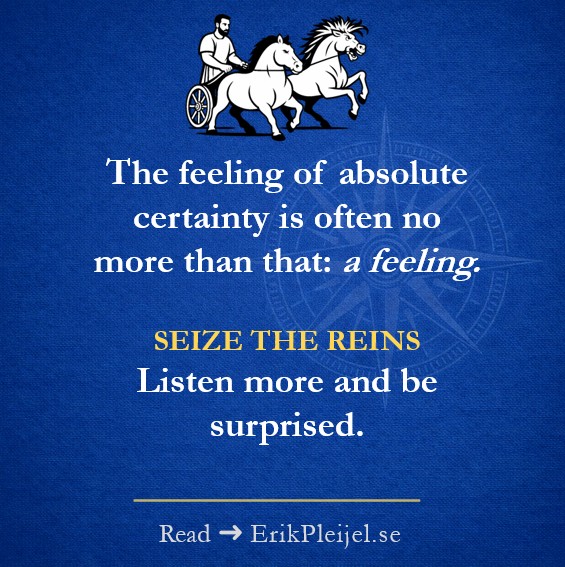
The feeling of absolute certainty is often no more than that: a feeling. It is rarely the product of a keen intellect. Not only that. Stubborn certainty is often reinforced by ignorance. The less you understand, the more entrenched you become in your beliefs. This tendency is exacerbated by information bubbles, where prejudices are always confirmed and never challenged.
To get out of this trap, we need to broaden our horizons and explore the world. One way is to meet people from other cultures and countries. Another is to learn about other eras by studying history. The collective experience of humanity is a vast source of knowledge.
When horizons are broadened, a new feeling arises: there is much we do not know. Socrates said that wisdom begins with recognising and admitting our ignorance.
This invites us to seek knowledge without prejudice and with a willingness to learn. Exploring the world becomes an adventure full of surprises.
Read books and take time to reflect. Social media makes us restless and unfocused. With a tiny attention span, we cannot develop wisdom. Let's start training our brains today!
💬 Ideas grow in group chats 🌱
6. Moderation: Avoid the Allure of Extremes
Demagogues possess a cunning intelligence that allows them to accumulate power and wealth. They are driven by an insatiable greed and gluttony. For them, 'enough' and 'contentment' are unfamiliar concepts.
It's not a good idea to elect rulers who can't rule themselves! Their lack of self-control – their inability to moderate their desires – makes them fundamentally unfit to lead. They do not have what it takes to make the world a better place: practical wisdom and good judgement. Because they foment division and polarisation, they tend to take radical positions and hold unbalanced views.
Practical wisdom, according to Aristotle, is related to moderation and self-control. It is often necessary to find the golden mean and not go too far in either direction. In decision-making situations, it is important not to overreact or underreact.
Sometimes we need to take a clear stand on an issue. But very often we have to find the right balance between two opposing poles. For example:
- Idealism and realism.
- Unity and diversity.
- Collectivism and individualism.
- Order and freedom.
It's about being able to hold together a complex reality – to be able to integrate.
7. Hope: Overcome Cynicism and the Appetite for Chaos
The gloomy state of the world makes it tempting to become cynical. It provides temporary relief and protects us from disappointment. But cynicism can also sap our vitality and deaden our spirit. We lose patience with the slow and painstaking work of improving things in small steps. It tempts us to join forces that tear down rather than build up. Cynicism can create an appetite for chaos.
What is the antidote to such destructive cynicism? Naïve optimism and rosy view of the world is fragile and easily shattered by events. Hope, on the other hand, has a spiritual quality that is stronger and deeper. It is a life force that is "not of this world" and transcends the limitations of reality. It is relatively independent of life's ups and downs and is a source of strength even when the future looks bleak.
The anti-Nazi resistance fighter Dietrich Bonhoeffer described it as
a living force, a power to hope where others give up, a power to hold one's head up high where everything seems to fail, a power to bear setbacks, a power that does not leave the future to the pessimist but claims it for hope.
Something Worth Living For
Bonhoeffer was a Lutheran pastor in Germany. When the Nazis came to power in the 1930s, he inspired young people to build spiritual resilience and equip them to resist these dark forces. People with faith like his can be the inspiration we need today.

We too live in dangerous times. Authoritarian leaders become popular by whipping up hatred and wrecking societies. They make the 'dark side' thrilling and entertaining. Emotions run high. We should not panic, for fear can lead us down the same dangerous path that hinders personal maturity and development.
We need the resilience to refuse the Faustian bargain. Let's counter fear with courage, the allure of power with just-mindedness, toxic emotions with love, pathological distrust with trusting faith, narrowmindedness with wisdom, extremism with moderation, and cynicism with hope.
Of these, I would say love is the most important – which may sound naïve. But consider this: so many movements are driven by negative emotions, by anger and contempt. If we fight evil with hatred, we easily become its mirror image. Recoiling from the bad is not enough. We need something that pulls us toward the good.
That is the case this book sets out to make. A God-centred humanism offers precisely that positive pull – a faith that doesn't just resist the demagogues' power cult, but points toward something worth living for.

💬 Ideas grow in group chats 🌱
ONE POSSIBLE ANSWER