


Chapter 10
X-Factor: Embrace Life's Mystery and Spark a Love of Science
Some say that science has demystified the world. Is this triumphalism an attempt to gain control over people's beliefs? There is a special case of the Faustian temptation.
This chapter deals with the origin of the world and life. Its purpose is not to question the scientific models of the Big Bang or evolution. What I am sceptical about is the popular but strange idea that these models provide support for atheism.
In the Beginning
It seems that many believers are uncomfortable with the Big Bang theory. The whole world was created with a bang, just like that. Science has explained everything and there is no need for God, say some atheists. Many believers feel provoked, while many atheists feel vindicated.
But it could also be the other way around. The person who coined the term "Big Bang" was the astronomer Sir Fred Hoyle, who was an atheist. He was initially very sceptical about the whole theory and suspected that its proponents had deeply religious motives. In an interview with the BBC, he said: "The reason why scientists like the 'Big Bang' is because they are overshadowed by the Book of Genesis [i.e. the creation story in the Bible]. It is deep within the psyche of most scientists to believe in the first page of Genesis." He invented the term as a mockery.
For an atheist that really understands science, the Big Bang can be a rather provocative theory. It is not about the creation of the universe, but about its history. Specifically, what happened in the first microseconds, hours and years, and how the universe expanded and cooled.
How it all began, how the "explosion" itself was initiated, how matter and the laws of nature were created – these are questions about which science finds it difficult to even speculate. If a miracle is an event without a natural cause, then the entire universe is one gigantic miracle.
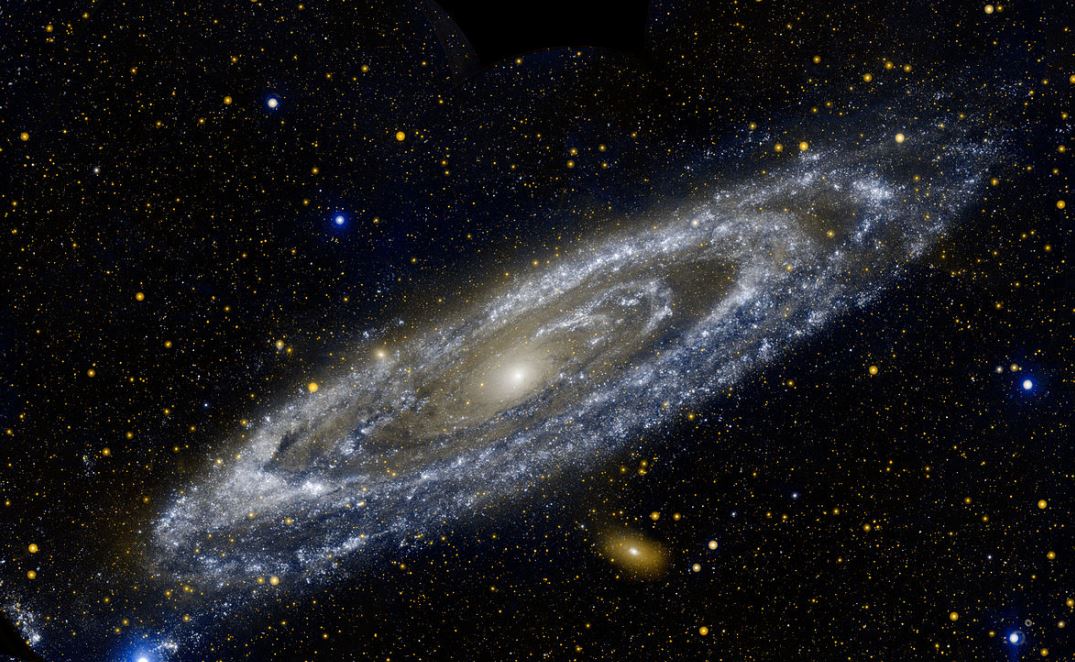
The Big Bang does not explain the creation of the world, but its historical evolution. Similarly, Darwinism does not explain the creation of life, but its evolution. How the first living cell came into being is a notoriously difficult puzzle for science to solve. The two most important questions – the creation of the world and of life – are unanswered by science.
Beware of The Illusion of Understanding
Evolutionary biologist Henry Gee blames the mass media and popular science for spreading false ideas about evolution. In an article in the journal Nature, he writes:
We've all seen the commercials. A line of figures walking from left to right, first a shambling ape on all fours; the second, semi-erect with a vague glimmer of intelligence, and perhaps holding a hand-axe; further along, a tall, proud man, carrying a spear and wearing furs; and finally, a user of the latest car or washing machine. The caption will speak of advancement and progression, something like "Evolution – the Next Step".
What Gee objects to is that such images give the false impression that evolution is some kind of progressive principle of improvement. Nature is seen through the lens of human optimism. You are led to believe that there is an inherent force in nature that pulls everything towards the higher, the better, the stronger.
There is hardly any doubt that species have evolved over time, but popular science sometimes gives explanations that have nothing to do with serious science. For example, they use phrases like "the struggle for survival leads to the improvement of species as weaknesses are gradually eliminated" and "nature's blind watchmaker randomly produces new prototypes" and "nature uses the principle of trial and error". And so on.
This brings to mind competing companies that are driven to constantly improve their products. Or innovators creating and refining their inventions. You see similarities between very different things and get a strong sense that everything fits together – "synthesis without analysis". It is believed that competition among animals is similar to competition among humans, and that both cases lead to the same kind of progress and development.
Nature is thought to work in much the same way as human creativity and invention, which is rational and goal oriented. Many people therefore believe – unconsciously – that nature is imbued with a human-like intelligence and will.
It becomes somewhat comical when one realises that many who claim to be atheists actually believe in a supernatural vital force. Needs that are denied in the conscious mind often play their tricks in the subconscious.
The Mysterious X-Factor
Over hundreds of millions of years, bacteria have evolved into lions, birds and humans. The question is, how did this happen? Everyone should agree that mutation and natural selection are at least part of the explanation. It is a combination of law and chance. But scientists disagree about which is more important. So there are two schools of thought, one emphasising law and the other chance.

To understand the difference, imagine a casino where the player is pitted against the "house" (i.e. the casino owner). A game like roulette is designed so that the house always wins in the long run. In order to make a profit, the house must ensure that the odds and laws of probability are in its favour. However, the player can win if he is lucky. So he has to rely on chance. Or he can hope for a miracle.
Serious scientists look for regularities in nature and try to explain them. Their reasoning is analytical. It revolves around observations, experiments, DNA molecules and proteins. Like the casino owner, they are interested in mathematical calculations of the odds.
On the other side there are those who have a strong belief in the creative power of chance. "Chance believers" do not calculate the odds or think analytically. They make no distinction between what is possible and what is plausible. They are arguing less like scientists and more like gambling addicts.
If evolution is a law-based process, then it is hard to escape the idea that everything has been planned from the very beginning. Why are the laws of nature formulated in such a way that matter is self-creating and develops life?
Law-evolution can lead to the idea of God as the legislator of nature. This position suggests that the laws of nature – and perhaps even the first living cell – were designed in such a way that life would inevitably emerge and grow in complexity. God becomes something like a master programmer who writes the code and presses "Enter." Once everything is set in motion, nature takes care of itself. God creates the universe and life's starting point, but then steps back. He is not a micromanager of his creation. This is a more or less strict form of what is known as "deism."
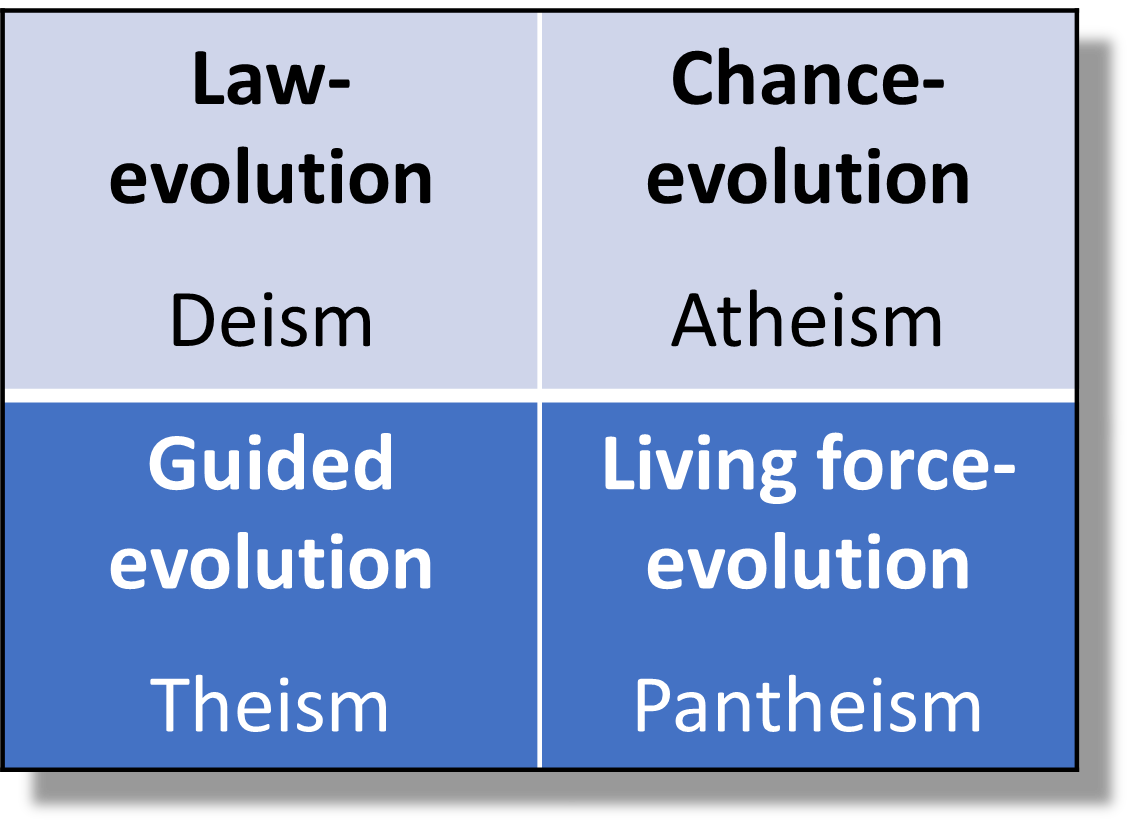
In the second case, chance-evolution, there is no need for a God. This is something that fits well with atheism. The path from bacteria to birds depended on a long series of lucky accidents.
But how can you tell whether an improbable event was the result of blind luck or a godsent wonder? Who can tell the difference between chance and miracle? Chance-evolution leaves the door wide open for God.
Guided evolution means that species were created by an intelligence. This position fits well with the idea that God creates everything with his finger, i.e. theism. A related alternative is living force evolution, which is similar to pantheism. It is also known as vitalism.
Whichever way you look at it, it is hard to escape a mysterious X-factor. It is difficult to find a position that provides a firm and secure foundation for atheism.
Placeholder · quote card
The True, the Good, the Beautiful
If evolution were driven solely by the principle of survival of the fittest, we would presumably value those qualities that favour our physical survival. But everything does not fit into this pattern.
How is it possible that a brain shaped by life in the jungle and savannah could produce such sophisticated intellectual endeavours as algebra, quantum physics and space exploration? How can you ascribe almost divine qualities to the mind while claiming that man is nothing more than an animal?
If the human brain is built purely for survival, then the scientist is little more than a master manipulator – incapable of seeking truth for its own sake. To trust science at all, we must believe reason reaches beyond survival – hungry not only for food, but for truth.
Think about how we care for others, even if they do not directly contribute to our survival. We care for all children, regardless of ability, and we care for the elderly, whether they are productive or not. This is a clear sign that we value more than just survival. Many of us react with resistance to cold, rational calculations that suggest we should get rid of the weakest.
Also, why is it in our genes to love music? Isn't this an unnecessary trait for a 'survival machine'? Music has been man's constant companion throughout history. It is deeply rooted in the human soul. The value of music is enormous, even if it serves no direct practical purpose.
Science is a quest for truth. Ethics is the quest for what is good and right. Art is the quest for the beautiful. The true, the good, the beautiful – this is sometimes called "the Platonic Trinity". Does it originate from the mysterious X-factor?
The Thrill of Emptiness
Some people believe there are simple explanations for things like art. They argue that music, for example, provided evolutionary advantages – such as strengthening group cohesion or promoting pair bonding. Over time, such benefits helped this trait spread.
Anyone who thinks critically will pause here and ask a few questions. It is an explanation, certainly – but is it a good one? Does it really account for our love of Beethoven's symphonies, for example? A healthy response is to dig deeper and analyse whether it truly holds up.
Some people seem ready to accept such explanations without hesitation. The reason may be less intellectual than emotional: there is a certain thrill in emptiness. If nothing stands above me, then I stand at the top of the world. By insisting that the universe is empty, they gain a sense of total control.
This becomes a kind of reverse faith – one they are unwilling to examine. It creates a blind spot in what they call "rationality." The conclusion comes first: the universe is void of meaning and purpose. The evidence is then arranged to fit it. What emerges is a fixed dogma of meaninglessness – ironically at odds with the very virtue of critical thinking.
There is no doubt that the Darwinian principle – random mutation and natural selection – can explain a great deal. The concern is that some try to force-fit everything into this framework. Even if that were successful, it would arguably point more toward deism than atheism. The origin of the first living cell remains the ultimate enigma – the spark that set the evolutionary engine in motion. The idea that science can explain away meaning and purpose altogether is an atheist pipe dream.
There are those who believe they can solve the mystery of life's origin and complexity. They don't seem to grasp the immensity of the challenge. They are not unlike a gambler who thinks he has a system that can beat the house. He wants there to be a solution. The desire to detect a pattern is strong – and so he spots one. He confuses the feeling of understanding with actual understanding. His willpower has taken charge of his intellect.

Beyond the Illusion of Control
Excessive faith in reason can, paradoxically, damage reason. When we demand answers to everything, we often settle for poor answers, thereby abandoning the true quest for truth.
Science has not and will never demystify the world. On the contrary, the more you discover, the more you realise how little you know. This is true of the individual as well as of science as a whole. The mysteries just keep getting deeper.
Albert Einstein said:
The most beautiful and deepest experience a man can have is the sense of the mysterious. It is the underlying principle of religion as well as all serious endeavour in art and science. He who never had this experience seems to me, if not dead, then at least blind.
We must let go of the intellectual desire for control and accept that there are things we will never understand. We need to move away from the illusion of understanding towards genuine insight, however limited. In this age of growing anti-science sentiment, we need to light a spark of love for sound science and real truth-seeking.

💬 Ideas grow in group chats 🌱